How AI-Native Backend Systems Are Transforming Modern Software Platforms
Introduction
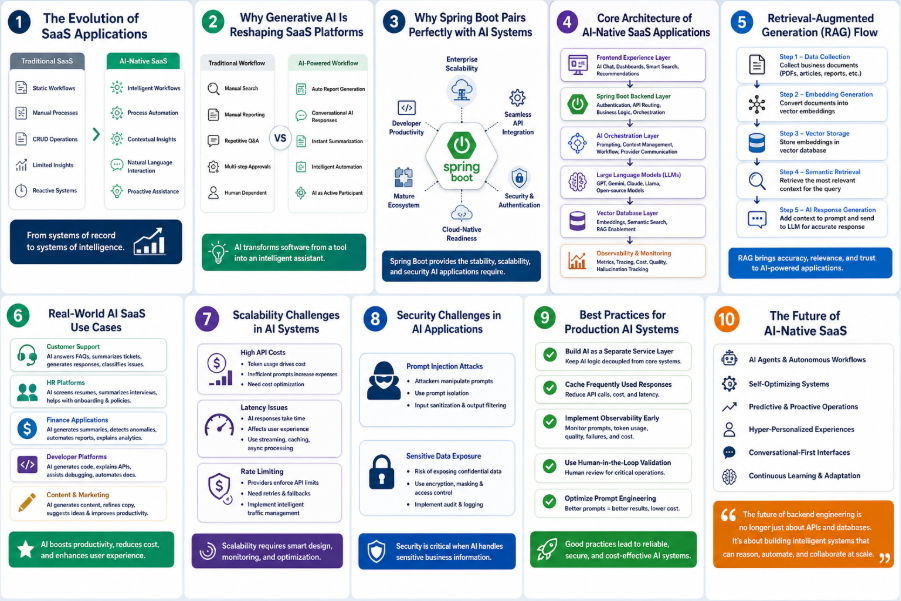
The software industry is entering a new architectural era.
For years, most SaaS applications were built around traditional backend patterns:
- REST APIs
- relational databases
- authentication systems
- CRUD-based workflows
These systems were efficient for managing business operations, but they lacked intelligence.
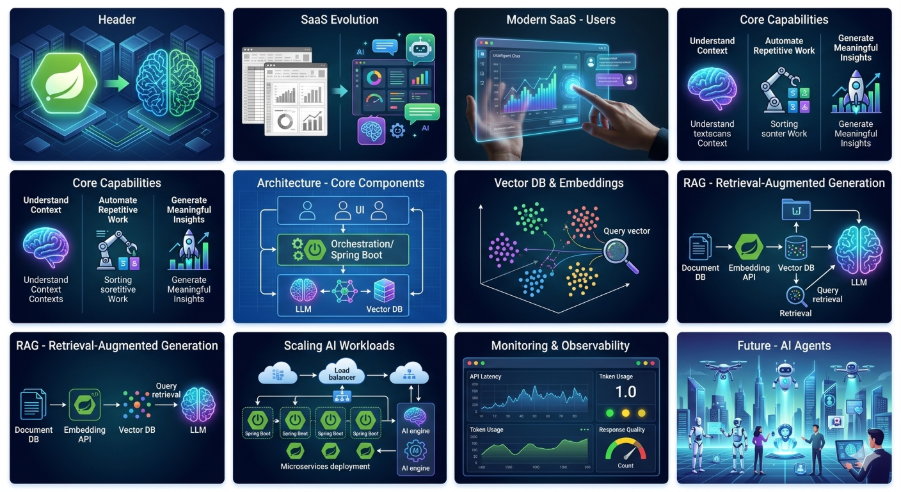
Modern users no longer want applications that simply store and display data. They expect platforms that can:
- understand context
- automate repetitive work
- generate meaningful insights
- assist decision-making
- communicate naturally
This shift is pushing SaaS platforms toward AI-native architecture.
Generative AI is no longer an optional feature added to applications as an experiment. It is rapidly becoming a core capability in modern software systems. Companies are integrating AI into customer support, analytics, automation, content generation, recommendation engines, and internal productivity tools.
At the center of this transformation, Spring Boot provides a strong foundation for building scalable, secure, and production-ready AI-powered applications.
With its mature ecosystem, microservice support, cloud-native capabilities, and seamless API integration, Spring Boot enables developers to combine enterprise-grade backend systems with the power of Large Language Models (LLMs).
This article explores how Spring Boot and Generative AI together are reshaping modern SaaS architecture.
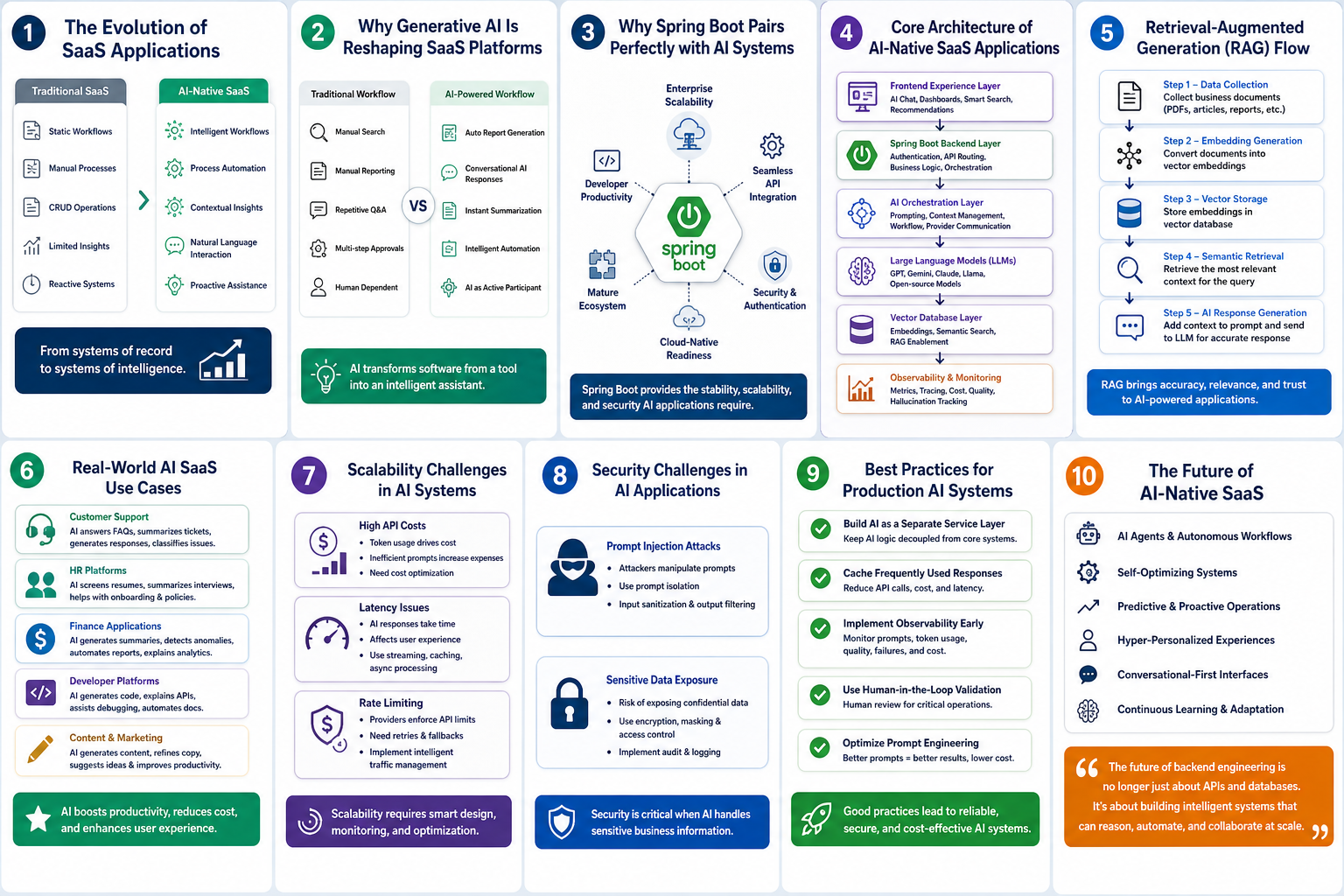
The Evolution of SaaS Applications
The first generation of SaaS applications focused primarily on digitizing manual processes.
Examples included:
- inventory systems
- HR management tools
- CRM platforms
- accounting software
- project management applications
These systems improved accessibility and centralized business data, but user interactions remained mostly static.
Modern SaaS platforms are evolving beyond static systems into intelligent ecosystems.
Today’s applications are expected to:
- predict user needs
- provide contextual recommendations
- automate operational workflows
- generate content dynamically
- support natural language interaction
This evolution represents a major architectural transformation.
Instead of applications acting only as tools, they are becoming intelligent assistants.
Why Generative AI Is Reshaping SaaS Platforms
Generative AI introduces capabilities that traditional rule-based systems struggle to achieve.
Unlike fixed logic systems, AI models can:
- interpret natural language
- summarize information
- generate new content
- understand semantic meaning
- perform contextual reasoning
This dramatically changes how users interact with software.
Traditional Workflow vs AI-Powered Workflow
Traditional Systems
In conventional SaaS applications:
- users manually search data
- employees create reports manually
- support teams answer repetitive questions
- workflows require multiple human approvals
The software acts only as a storage and transaction layer.
AI-Powered Systems
In AI-native systems:
- reports can be generated automatically
- customer queries can be answered conversationally
- documents can be summarized instantly
- repetitive workflows can be automated intelligently
The software becomes an active participant in business operations.
Why Spring Boot Works Exceptionally Well with AI Systems
Spring Boot remains one of the most trusted backend frameworks for enterprise applications.
Its flexibility and scalability make it highly suitable for AI-powered architectures.
1. Enterprise Scalability
AI workloads can become computationally intensive.
Applications may process:
- thousands of AI requests
- document embeddings
- semantic searches
- streaming responses
- asynchronous tasks
Spring Boot supports:
- distributed systems
- horizontal scaling
- cloud-native deployment
- container orchestration
This allows AI applications to scale efficiently in production environments.
2. Seamless API Integration
Most Generative AI systems rely heavily on external APIs.
Spring Boot simplifies:
- REST communication
- WebClient integration
- asynchronous API calls
- request handling
- retry mechanisms
Developers can easily integrate:
- OpenAI APIs
- Gemini APIs
- Claude APIs
- internal AI services
without building complex networking layers manually.
3. Security and Authentication
AI systems often process highly sensitive information.
Examples include:
- customer documents
- business analytics
- financial records
- internal communications
Spring Security helps secure AI systems using:
- OAuth2
- JWT authentication
- role-based access control
- API authorization
- request validation
Security becomes especially important when AI systems are integrated into enterprise workflows.
4. Cloud-Native Readiness
Modern AI systems are typically deployed using:
- Docker
- Kubernetes
- serverless platforms
- distributed microservices
Spring Boot integrates naturally with cloud infrastructure, making deployment and scaling significantly easier.
Core Architecture of AI-Native SaaS Applications
A modern AI-powered SaaS platform usually contains several architectural layers working together.
Each layer has a specific responsibility.
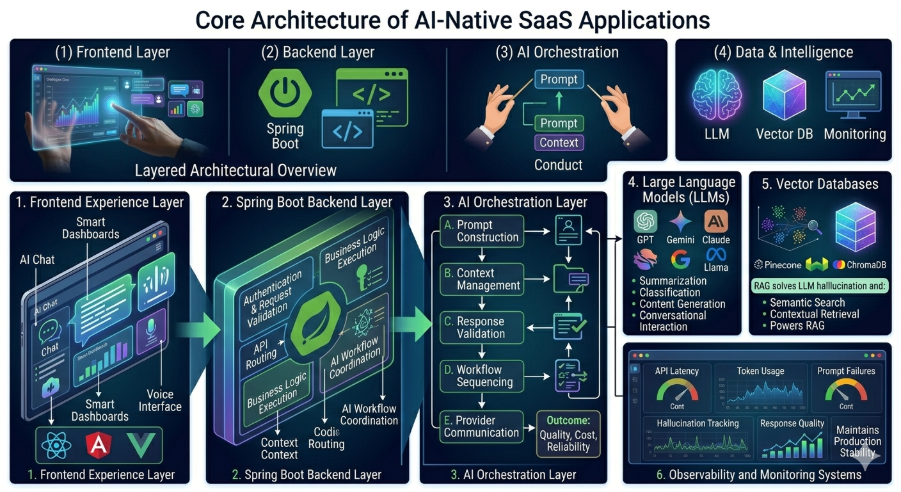
1. Frontend Experience Layer
This layer handles user interaction.
Modern AI interfaces often include:
- AI chat windows
- smart dashboards
- voice interaction
- intelligent search
- contextual recommendations
The frontend communicates with backend AI services through APIs.
Popular frontend technologies include:
- React
- Angular
- Vue.js
2. Spring Boot Backend Layer
This layer acts as the core orchestration engine.
Responsibilities include:
- authentication
- request validation
- API routing
- business logic execution
- AI workflow coordination
Spring Boot becomes the bridge between business systems and AI capabilities.
3. AI Orchestration Layer
This is one of the most critical components in modern AI systems.
The orchestration layer controls:
- prompt construction
- context management
- response validation
- workflow sequencing
- provider communication
Good orchestration determines:
- response quality
- reliability
- cost efficiency
- scalability
In many systems, orchestration is more important than the AI model itself.
4. Large Language Models (LLMs)
LLMs provide the intelligence layer.
Examples include:
- GPT models
- Gemini
- Claude
- open-source models like Llama
These models perform tasks such as:
- summarization
- classification
- content generation
- conversational interaction
- reasoning
5. Vector Databases
Traditional databases struggle with semantic understanding.
Vector databases solve this problem using embeddings.
They allow applications to:
- perform semantic search
- retrieve contextual information
- power Retrieval-Augmented Generation (RAG)
Popular vector databases:
- Pinecone
- Weaviate
- ChromaDB
6. Observability and Monitoring Systems
AI systems require advanced monitoring because traditional backend metrics are no longer sufficient.
Monitoring should include:
- API latency
- token usage
- prompt failure rate
- hallucination tracking
- AI response quality
- cost analytics
Observability tools help maintain production stability.
Retrieval-Augmented Generation (RAG)
One of the biggest limitations of LLMs is their lack of real-time business knowledge.
LLMs may:
- hallucinate information
- provide outdated answers
- lack organizational context
RAG solves this issue.
How RAG Works
Step 1 — Data Collection
Business documents are collected.
Examples:
- PDFs
- internal policies
- reports
- knowledge base articles
Step 2 — Embedding Generation
Documents are converted into vector embeddings.
Embeddings represent semantic meaning mathematically.
Step 3 — Vector Storage
Embeddings are stored in a vector database.
Step 4 — Semantic Retrieval
When users ask questions, the system retrieves relevant contextual information.
Step 5 — AI Response Generation
The retrieved context is added to the prompt before sending it to the LLM.
This significantly improves accuracy.
Benefits of RAG Architecture
Improved Accuracy
Responses become context-aware and business-specific.
Reduced Hallucinations
AI relies on actual company data instead of guessing.
Real-Time Knowledge
Applications can answer questions using the latest business information.
Better User Trust
Reliable AI systems improve adoption and customer confidence.
Real-World AI SaaS Use Cases
Generative AI is already transforming multiple industries.
Customer Support Platforms
AI assistants can:
- answer FAQs
- summarize tickets
- generate responses
- classify customer issues
This reduces operational workload significantly.
HR Platforms
AI can help with:
- resume screening
- interview summarization
- employee onboarding
- policy assistance
Finance Applications
AI systems can:
- generate financial summaries
- detect anomalies
- automate reporting
- explain analytics
Developer Platforms
AI copilots can:
- generate code
- explain APIs
- assist debugging
- automate documentation
Scalability Challenges in AI Systems
AI systems introduce entirely new scalability concerns.
High API Costs
LLM providers charge based on token consumption.
Without optimization:
- operational costs can rise rapidly
- inefficient prompts increase expenses
- scaling becomes difficult
Latency Issues
AI requests may take several seconds.
Poor response times negatively impact user experience.
Solutions include:
- streaming responses
- asynchronous processing
- caching
- queue-based workflows
Rate Limiting
Most AI providers enforce API limits.
Production systems need:
- retries
- fallback providers
- intelligent traffic management
Security Challenges in AI Applications
AI introduces unique security risks that traditional systems rarely faced.
Prompt Injection Attacks
Attackers may manipulate prompts to bypass restrictions.
Protection strategies include:
- prompt isolation
- input sanitization
- validation filters
- output moderation
Sensitive Data Exposure
AI systems should never expose:
- credentials
- financial data
- private user information
Organizations must implement:
- encryption
- secure logging
- masking policies
- audit systems
Best Practices for Production AI Systems
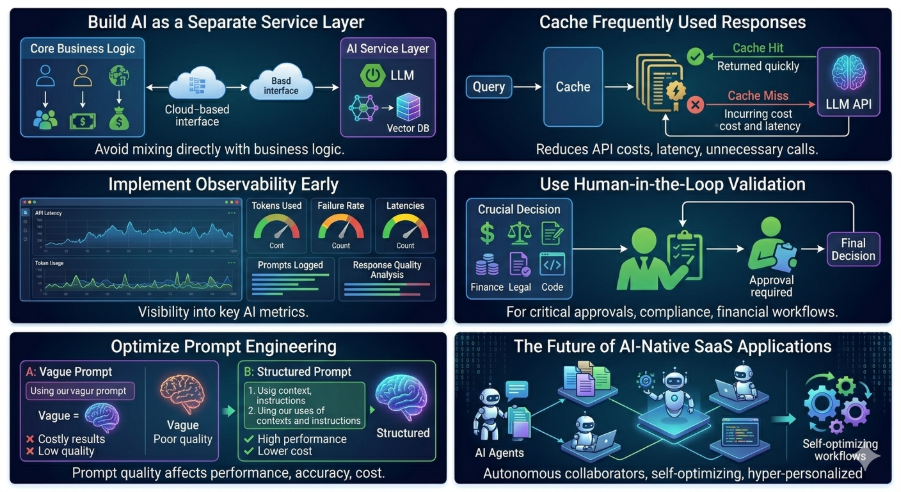
Build AI as a Separate Service Layer
Avoid mixing AI logic directly with core business logic.
Cache Frequently Used Responses
This reduces:
- API costs
- latency
- unnecessary model calls
Implement Observability Early
AI systems require visibility into:
- prompts
- token usage
- response quality
- failures
Use Human-in-the-Loop Validation
For critical operations:
- approvals
- compliance
- financial workflows
human review remains essential.
Optimize Prompt Engineering
Prompt quality directly affects:
- performance
- accuracy
- operational cost
Good prompts are now part of software architecture.
The Future of AI-Native SaaS Applications
We are moving toward a future where applications become autonomous collaborators rather than passive tools.
Future systems may include:
- AI agents
- self-optimizing workflows
- autonomous task execution
- predictive operations
- hyper-personalized user experiences
SaaS platforms will increasingly rely on:
- conversational interfaces
- intelligent automation
- contextual understanding
- continuous learning systems
This shift will fundamentally redefine backend engineering.
Conclusion
Spring Boot and Generative AI together create a powerful foundation for modern SaaS applications.
Spring Boot provides:
- scalability
- reliability
- security
- enterprise integration
Generative AI adds:
- intelligence
- automation
- contextual understanding
- conversational experiences
Together, they enable developers to build systems that are not only functional but truly intelligent.
The next generation of SaaS platforms will not simply manage workflows.
They will understand users, automate decisions, generate insights, and actively participate in business operations.
Developers who understand AI-native architecture today will help define the future of software engineering tomorrow.
Final LinkedIn Closing Statement
“The future of backend engineering is no longer just about APIs and databases.
It’s about building intelligent systems that can reason, automate, and collaborate at scale.”