
Why Manual Workflows Persist When Business Applications Don't Connect
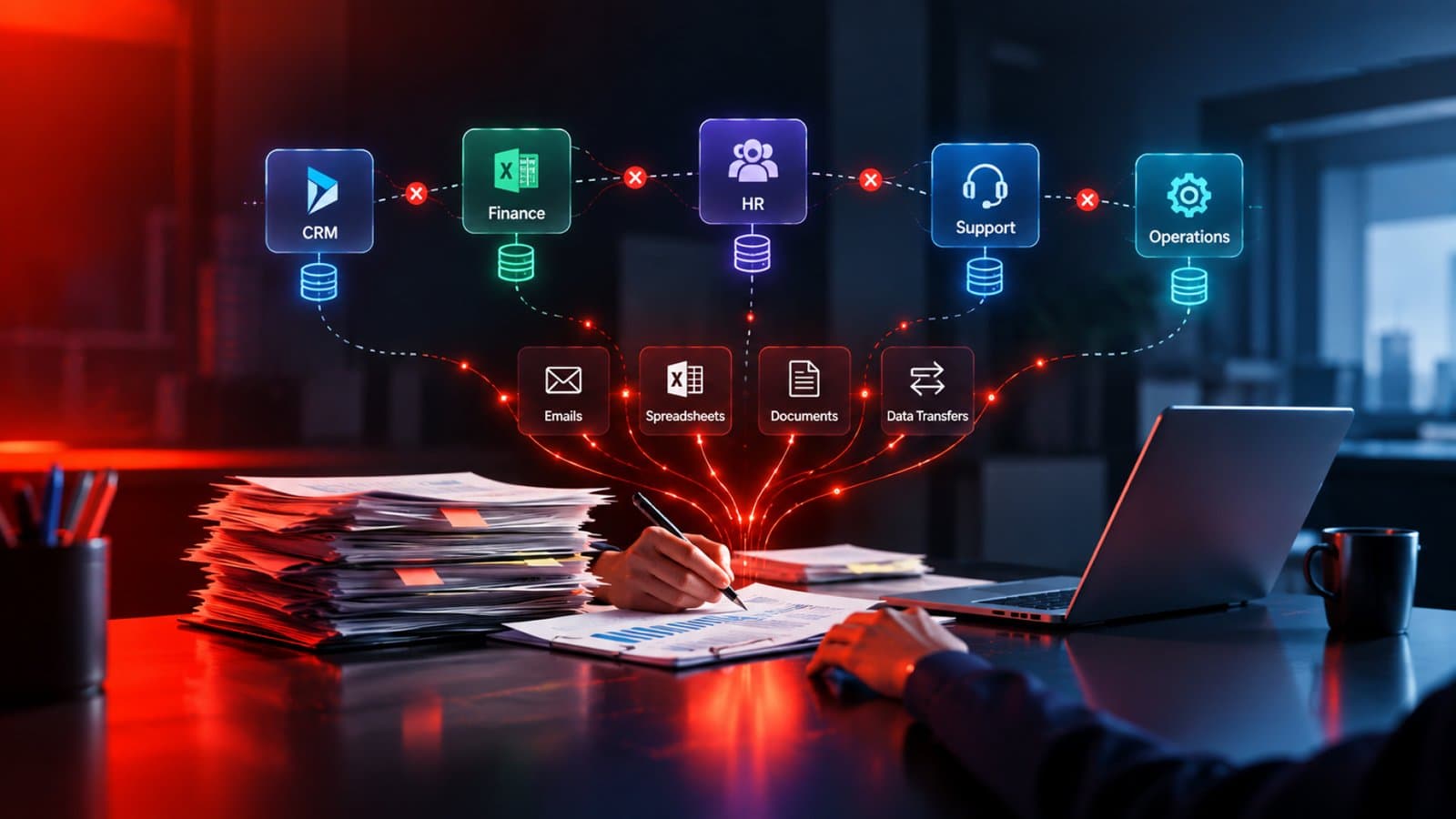

An HR coordinator enters a new hire's details into the HR system, then enters the same information into payroll, and then again into an IT provisioning tool.nA procurement manager approves a purchase order in one application, then updates a spreadsheet so finance knows what happened.nNobody designed these processes to be manual. They became manual because the applications involved don't share information automatically.nAnd when software can't connect the workflow, people become the integration layer.n
When People Become the Connection Between Systems
Most manual workflows don't start as major problems.nSomeone creates a spreadsheet because two systems don't connect. A team adds an approval step because another department needs visibility. An employee copies information from one application to another because there is no automated way to transfer it.nThe workaround solves the immediate problem.nThen it becomes part of the process.nOver time, these small workarounds accumulate. Employees spend more time moving information than acting on it. Managers rely on spreadsheets to understand progress. Processes become dependent on people remembering exactly what needs to happen next.nThe business may have invested in sophisticated applications, yet the work connecting those applications is still happening manually.n
The Hidden Cost of Manual Work
The obvious cost is time.nBut repetitive data entry creates several other problems that are harder to see.n
Errors multiply.n Every manual transfer creates another opportunity for information to be entered incorrectly, missed, or updated in one system but not another.nProcesses slow down.n A workflow cannot move to the next stage until someone completes the manual step.nVisibility disappears.n When progress depends on emails, spreadsheets, and individual actions, it's difficult to know where a request actually stands.nKnowledge becomes personal.n If only one or two people know how a process works, their absence can create an immediate operational problem.nEmployees spend time on coordination instead of work.n Skilled people end up transferring information between systems instead of using that information to make decisions or serve customers.nThe problem isn't that employees are doing the work incorrectly.n
The problem is that the process requires them to do work technology should be handling.
Find the Gaps in the Workflow
The answer isn't to automate everything.nn
Start with the workflows where manual intervention creates the greatest business impact.
Look for processes that:
- Run frequently
- Cross multiple applications
- Require repeated data entry
- Generate regular errors or rework
- Depend heavily on individual employees
- Create delays customers or other teams can feel
Employee onboarding, procurement, order processing, service requests, and approvals are often good places to look because they naturally move across departments and systems.nMapping one of these processes from beginning to end can reveal something important: the problem may not be the individual applications.n
It may be the gaps between them.
Automation Should Follow the Process
Once those gaps are visible, businesses can decide where automation actually makes sense.nAn API might transfer information automatically from one application to another. A workflow platform might trigger the next step when an approval is completed. An integration service might synchronize records between systems.nEven a small change can make a noticeable difference.nIf a new employee's information is automatically passed from HR to payroll and IT, three manual handoffs disappear from the onboarding process.nIf an approved purchase order automatically updates the relevant finance system, a spreadsheet no longer needs to act as the bridge.nThe objective isn't automation for its own sake.n
It's removing unnecessary human involvement from predictable steps while keeping people involved where judgment is required.
Connect the Systems Behind the Work
Integration is what makes this possible.nAPIs and integration platforms can allow applications to exchange information without manual intervention. Workflow automation can coordinate actions across systems. Cloud platforms can bring related capabilities together where consolidation makes sense.nFor systems that cannot be easily replaced or connected, businesses can still modernize the surrounding workflow and reduce the amount of manual work required.nThe result is a process where information moves with the work instead of waiting for someone to move it.nThat creates more than efficiency.nIt creates consistency, traceability, and visibility.n
Automation Doesn't Mean u201cSet It and Forget Itu201d
A workflow that works today may need to change tomorrow.nBusiness processes evolve. Applications are upgraded. New systems are introduced. Data structures change.nThat means automated workflows need ownership.nBefore automating, businesses should establish:nData standards — so automation doesn't spread inconsistent information faster.nProcess ownership — so someone is accountable for the complete workflow.nIntegration strategy — so today's connection doesn't become tomorrow's technical debt.nUser adoption — so employees understand how their role changes when manual steps disappear.nOngoing maintenance — so workflows continue working as the business and its applications evolve.nAutomation should reduce dependency on individual people, not create a new dependency on undocumented technology.n
A Better Role for People
The best outcome of workflow automation isn't simply fewer clicks.nIt's giving people their time back.nAn HR professional should spend more time helping employees settle into the organization, not copying employee information between systems.nA procurement manager should focus on purchasing decisions, not maintaining a spreadsheet that tells another department what the system already knows.nWhen applications exchange information automatically, people can spend more time on the parts of the process that require judgment, communication, and expertise.n
Conclusion
Manual workflows persist because disconnected applications leave gaps that someone has to fill.nThe answer isn't to automate every process or replace every application. It's to identify where people are repeatedly acting as the bridge between systems and decide where technology can take that work over.nAthen helps businesses connect applications, automate workflows, and reduce the manual effort created by disconnected systems.n
If your teams are spending too much time moving information between applications, talk to Athen about where workflow automation can make the biggest difference.