How to Build an AI Implementation Strategy for Your Business
Start with the question most AI plans skip: which tasks should you leave alone?
Picture a familiar situation. Your finance team spends hours collecting information from different systems. Your operations team manually follows up on pending tasks. Your employees search through folders, emails and spreadsheets just to find information that should be readily available. Someone suggests introducing AI. It sounds reasonable. Automate the reporting. Speed up the follow-ups. Give employees an AI assistant. But there is a question worth asking before any implementation begins: Does this problem actually need AI?
Not every repetitive task deserves an AI solution. Some need better processes. Others need conventional automation. A few may not be worth solving at all. An effective AI implementation strategy is about identifying where AI can create measurable business value, preparing the organisation to use it, and knowing when not to proceed.
Why AI Implementation Strategies Fail Before Development Begins
AI projects often begin with enthusiasm rather than a clearly defined business problem. A department identifies a new AI capability, leadership approves an experiment, and a team starts exploring tools. But somewhere between the initial idea and actual deployment, the business objective becomes unclear. In a 2024 RAND Corporation study, researchers interviewed 65 experienced data scientists and engineers about why AI projects fail. The report cited estimates that more than 80% of AI projects fail, roughly twice the rate of IT projects without AI. This figure should be treated as an estimate rather than a universal failure rate. More importantly, the research highlighted several recurring problems.
- The problem was never clearly defined. Teams started building solutions without agreeing on the actual business problem.
- The required data wasn't available. Information was incomplete, inaccessible or inconsistent.
- Technology became the objective. Organisations focused on experimenting with AI instead of solving real user problems.
- The infrastructure wasn't ready. Existing systems and workflows couldn't support the implementation.
- The problem was unsuitable for AI. Some tasks were too complex or dependent on judgement that couldn't reliably be automated.
Start with the business problem, not the AI capability.
These challenges point to an important conclusion: AI implementation strategy begins well before selecting a model, platform or development partner.
Step 1: Identify the Business Problem Before Choosing AI
The first step is to understand how work actually happens inside your organisation. Avoid starting with broad requests such as "We need an AI chatbot" or "We should automate our reporting." These describe potential solutions, not business problems. Instead, identify the actual task, the people involved and the outcome expected.
Ask Five Questions About Every Potential Use Case
- Who: Who performs this task?
- What: What exactly needs to be completed?
- When: How frequently does it happen?
- How: Which systems, documents or processes are involved?
- Why: What business impact does the task have?
Example: From a Vague Idea to a Defined Problem
Initial idea: We need AI for reporting. Actual problem: Three employees spend every Friday afternoon collecting operational figures from two different systems, checking inconsistencies and preparing a spreadsheet for management. Now you have something measurable. You can investigate the time involved, the error rate, the systems being used and the potential value of improving the process.
Step 2: Prioritise AI Opportunities Based on Value and Effort
Once you understand the problems, the next challenge is deciding which ones deserve attention first. Not every opportunity should receive the same investment. Some offer significant business value with relatively little implementation effort. Others require substantial data preparation, integration and ongoing oversight. Evaluate each opportunity across two dimensions.
Business Value
- How frequently does the task occur?
- How much employee time does it consume?
- What is the cost of errors or delays?
- Does it affect customers or business operations?
- Could improving it benefit multiple departments?
Implementation Effort
- Is the required data available and accessible?
- Are the existing processes consistent?
- How many systems need integration?
- How much human review is required?
- What security and governance requirements apply?
The AI Opportunity Prioritisation Matrix
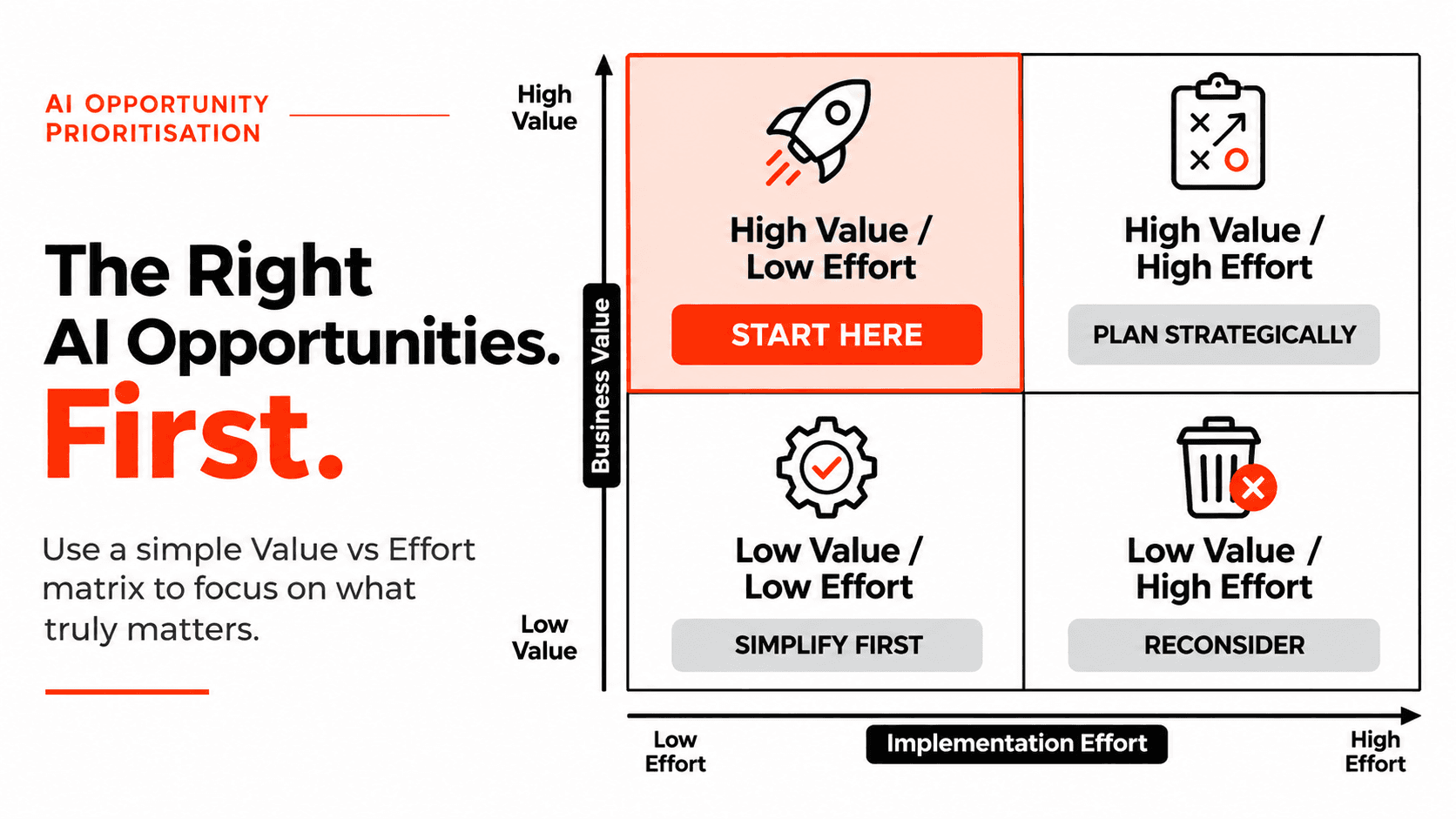
- High Value + Low Effort — Start Here. Strong candidates for an initial pilot.
- High Value + High Effort — Plan Strategically. These require preparation, technical planning and stakeholder alignment.
- Low Value + Low Effort — Simplify First. A better template, spreadsheet formula or workflow rule may be enough.
- Low Value + High Effort — Reconsider. The investment may not justify the expected business value.
Frequency alone doesn't determine value. A process performed once a year may still deserve attention if an error could cause substantial financial or operational damage.
Step 3: Let Doing Nothing Compete With AI
This is one of the most overlooked parts of an AI implementation strategy. When organisations evaluate a problem, they often compare different AI tools. But the better comparison includes alternatives that don't involve AI at all. Before approving an AI initiative, consider four possible approaches.
Option 1: Improve the Existing Process
Sometimes the real issue is unnecessary steps, unclear responsibilities or poor coordination. Fixing the process may eliminate the problem entirely.
Option 2: Use Conventional Automation
If a task follows predictable rules and consistent inputs, traditional automation may be sufficient. Examples include: - Automatically moving information between systems. - Sending scheduled notifications. - Updating records based on predefined conditions. - Generating reports from structured data.
Option 3: Introduce AI
AI becomes more valuable when work involves unstructured information, variable inputs, language understanding or decisions that cannot be captured through simple fixed rules. Examples include extracting information from different document formats, searching internal knowledge, classifying customer enquiries and summarising complex business documents.
Option 4: Do Nothing
If the problem has little business impact and solving it requires disproportionate investment, leaving it alone may be the most sensible decision.
Doing nothing is not a failure of innovation. Sometimes it is the best business decision.
The objective is to select the simplest approach that reliably solves the problem.
Step 4: Check Organisational Readiness Before Building
Even a valuable AI use case can fail if the organisation isn't prepared to support it. Before starting development, evaluate four areas of readiness.
1. Data Readiness
AI systems depend on information. Determine whether the necessary data is available, accurate, current and accessible. Check where the information lives, whether it is structured or unstructured, whether duplicates exist and who has permission to access it.
2. Process Readiness
AI should improve a process that people understand. If the workflow changes constantly or employees follow different procedures, standardise the process before introducing automation.
3. Ownership and Accountability
Every implementation needs an accountable owner. Identify who will oversee implementation, manage ongoing operations, monitor performance and handle exceptions or escalations.
4. Human Review and Governance
AI-generated outputs should not automatically be trusted in every business context. Define who reviews outputs, which decisions require human approval, how errors are handled and what information the system is permitted to access.
Step 5: Pilot One Workflow and Measure the Results
Once the opportunity has been prioritised and readiness has been assessed, move towards a controlled implementation. Avoid starting with an organisation-wide AI rollout. Choose one workflow with a clearly defined objective and manageable implementation scope.
Build Your Pilot Around Five Activities
- Establish a baseline. Record how the process works today, including time spent, error frequency and processing delays.
- Define the expected outcome. Decide what improvement would make the implementation worthwhile.
- Select the right solution. Evaluate technology, integrations, data requirements and security considerations.
- Test with real users. Collect feedback, identify limitations and monitor output quality.
- Make an evidence-based decision. Set a review date and decide whether to expand, improve, pause or stop the initiative.
What Should You Measure?
- Time saved — Whether the workflow is faster.
- Error rate — Whether output quality has improved.
- Adoption — Whether employees actually use it.
- Cost per task — Whether the process is more economical.
- Review effort — How much human oversight remains.
- Business impact — Whether the change delivers meaningful value.
A successful pilot isn't simply one where the AI works. It is one where the business benefits from using it.
Common Mistakes to Avoid When Planning AI Implementation
Even organisations with strong technical teams can make avoidable strategic mistakes. Watch out for these five:
- Starting with a tool instead of a problem. Choosing a platform before understanding the workflow can lead to unnecessary complexity.
- Automating a broken process. Technology rarely fixes unclear responsibilities and inconsistent workflows by itself.
- Ignoring data quality. Incomplete or unreliable information can undermine an otherwise well-designed solution.
- Underestimating human involvement. AI implementation still requires ownership, monitoring, validation and employee adoption.
- Scaling before measuring. Expanding an unproven pilot increases risk without establishing business value.
The best way to avoid these mistakes is to make problem selection and readiness assessment part of the implementation process.
Your AI Implementation Strategy: The Five-Step Framework
Before investing in an AI initiative, work through this checklist.
- Identify the problem: Define the task, people, frequency and expected business outcome.
- Prioritise the opportunity: Evaluate its business value against implementation effort.
- Compare alternatives: Consider process improvements, conventional automation and doing nothing.
- Assess readiness: Check data, processes, ownership and human oversight.
- Pilot and measure: Test one workflow, establish success metrics and decide what happens next.
Where to Go Next: Assess Your Organisation's AI Readiness
Having a list of potential AI opportunities is a good starting point. Knowing which ones your organisation is prepared to implement is the next challenge. Before moving into development, evaluate your current processes, information readiness and ability to operationalise AI. Athen's AI Readiness Assessment provides a starting point for understanding where your organisation stands and identifying opportunities worth exploring.