
Where Manual Processes Are Still Slowing Your Business Down

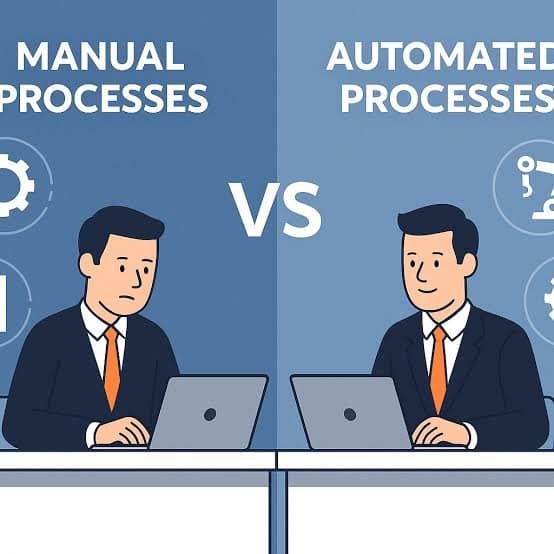
An invoice sits in an inbox waiting for someone to enter it into the finance system. A new hire's access request gets typed into three different tools. A weekly report is rebuilt from scratch every Monday because nobody automated the process. None of these tasks are particularly difficult. They're just repetitive — and quietly taking time away from work that actually needs people. Manual work rarely feels like a business problem because it becomes part of the routine. That's exactly why it can survive for years without being questioned.
The Business Challenge
Most organisations have processes that were created manually because, at the time, it was the simplest way to get the job done. As the business grows, those processes often stay the same. Employees spend time re-entering information, chasing approvals, preparing reports, and moving data between systems. Managers see the resulting delays, while customers may experience slower responses or approvals. The cost adds up. Manual processes take longer, create more opportunities for error, and become increasingly difficult to manage as transaction volumes grow. More importantly, they consume employee time that could be spent on work requiring judgement, expertise, and customer attention.
The Work That Shouldn't Need to Be Manual
The biggest automation opportunities are often hidden inside everyday processes.
Repetitive data entry: The same information is entered into multiple systems because those systems aren't connected.
Approval bottlenecks: Requests sit in inboxes waiting for someone to review, approve, or forward them.
Recurring reporting: Teams repeatedly collect, combine, and format information that could be pulled together automatically.
Multi-team handoffs: Processes such as onboarding, procurement, and service requests depend on people manually passing information from one stage to another.
These tasks may only take a few minutes individually. Across hundreds of employees and thousands of transactions, the lost time becomes significant.
Start With the Process, Not the Technology
The answer isn't to automate everything.
Start by looking at where people spend the most time doing work that follows a predictable pattern.
- Find high-frequency tasks: Look for work that happens repeatedly and follows clear rules.
- Map the handoffs: Identify where information moves between people, teams, or systems.
- Measure the effort: Understand how much time the current process actually consumes.
- Start with one useful process: A visible improvement can demonstrate the value of automation without creating a large transformation project.
- Give the process an owner: Someone needs to remain responsible for improving and maintaining it
The objective isn't to remove people from the process.
It's to remove the repetitive work that doesn't need people doing it manually.
Microsoft 365 Can Help Automate the Everyday
Many organisations already have capabilities that can reduce manual work within their existing Microsoft environment.
Power Automate can route approvals, trigger notifications, move information between systems, and automate repetitive workflows.
SharePoint and Microsoft Teams can provide structured places for information and processes to move, reducing the need to manage everything through email.
Power Platform can extend automation into business applications when a process needs more than a simple workflow.
Microsoft Copilot can also reduce manual effort in knowledge-heavy tasks, such as drafting communications, summarising information, and bringing together content from across the work environment.
The technology matters, but the process comes first. Automating a poorly designed process only makes the same problem happen faster.
The Opportunity Is Often Already in Your Business
Manual work doesn't always require a new system to solve. Sometimes the capability is already available within the technology the organisation owns. The real opportunity is identifying where that capability can replace repetitive work and connecting it to the way teams actually operate. A few well-chosen automations can free up meaningful capacity, improve consistency, and make everyday work easier without requiring a large transformation programme.
What manual work could your business stop doing by hand?
Athen helps organisations identify repetitive workflows and use Microsoft 365, Power Platform, automation, and connected business systems to make everyday processes simpler and more efficient.