AI Adoption: A Practical Roadmap for Enterprise Teams

AI Adoption: A Practical Roadmap for Enterprise Teams
How organisations can build AI maturity, prepare their workforce, manage organisational change and turn AI adoption into measurable business impact.
Why AI Adoption Is the Hardest Line Item on Every Roadmap Right Now
Nearly nine in ten organisations now report regular use of AI in at least one business function, and 44 percent say AI use now spans three or more functions enterprise-wide, according to McKinsey's 2026 State of AI survey. AI adoption has moved beyond experimentation. Organisations are integrating AI into everyday activities, but wider usage does not automatically translate into business transformation.
A RAND Corporation analysis also found that more than 80% of AI projects never reach production. The challenge is not simply getting employees to use AI tools. It is building an organisation capable of using AI consistently, responsibly and effectively. This requires leadership commitment, organisational knowledge, workforce readiness, governance, process alignment and a culture that supports continuous change.
The real measure of AI adoption isn't how many tools an organisation uses. It's how effectively the organisation changes the way work gets done.
This guide explores six dimensions of AI adoption readiness, four stages of organisational maturity and a practical roadmap for turning AI into a lasting business capability.
Why Enterprise AI Adoption Efforts Stall
Organisations invest in AI platforms, subscriptions and proof-of-concept projects. Yet many struggle to make these initiatives part of everyday operations. The problem often comes down to five organisational challenges:
- Technology without direction: Departments adopt different tools without shared business objectives.
- Fragmented organisational knowledge: Important information remains scattered across documents, emails and internal systems.
- Unprepared employees: Employees lack the training, confidence or clarity to incorporate AI into their responsibilities.
- Governance introduced too late: Access controls, accountability and data protection are addressed after adoption begins.
- No clear ownership: Different teams manage AI initiatives, but nobody is accountable for organisation-wide outcomes.
The Six Dimensions of Enterprise AI Adoption Readiness
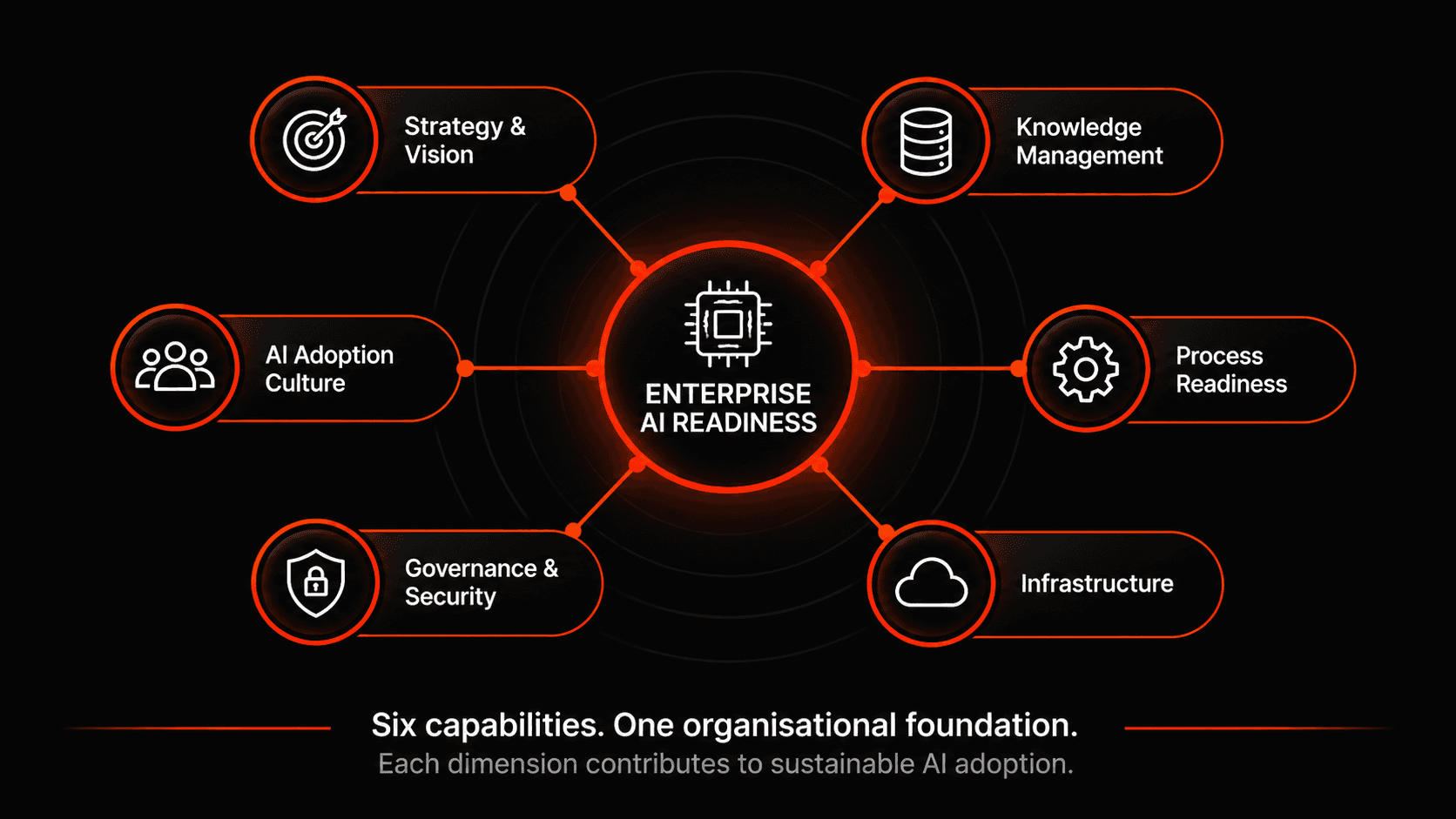
Enterprise AI adoption requires progress across six interconnected dimensions. Together, they help leadership understand whether the organisation is prepared to adopt AI beyond isolated experiments.
1. Strategy & Vision
Leadership must establish where AI supports business objectives, which capabilities deserve investment and what outcomes the organisation expects. Consider whether AI adoption is connected to business strategy, whether departments share priorities and whether investments are evaluated against measurable outcomes.
2. Knowledge Management
Business knowledge must be documented, structured, governed and accessible. Consider whether institutional knowledge is maintained, whether information is fragmented across systems and whether employees and AI solutions can access reliable information with appropriate permissions.
3. Process Readiness
Organisations need visibility into how work moves between departments, where information is exchanged and which activities depend on manual intervention. Consider whether workflows are documented, responsibilities are clear and employees understand where AI can improve existing work.
4. Infrastructure
Enterprise AI requires technology capable of supporting secure and reliable operations. Evaluate data platforms, cloud infrastructure, system integrations, identity management and whether existing systems can support increasing AI usage.
5. Governance & Security
Organisations need clear policies governing AI usage, sensitive information, access permissions, human oversight and accountability. Effective governance should build trust and support responsible adoption rather than become an obstacle introduced after deployment.
6. AI Adoption Culture
Employees ultimately determine how effectively AI becomes part of everyday work. Practical training, employee participation, knowledge sharing and confidence in using AI responsibly help create a culture where people see AI as a way to improve their work.
Strong infrastructure without governance creates risk. A clear strategy without employee readiness creates resistance. Enterprise AI maturity depends on all six dimensions working together.
The Four Maturity Levels of AI Adoption
Organisations rarely move from experimentation to enterprise-wide AI adoption immediately. They progress through different stages as their strategy, capabilities, workforce and governance evolve.
- Ad Hoc / Exploring: Individual employees and departments experiment with AI. There is no shared strategy, consistent governance or organisation-wide visibility.
- Developing: Leadership establishes priorities, initial policies and training programmes. Departments begin identifying opportunities and strengthening their foundations.
- Scaling: AI becomes established across multiple functions. Employees receive structured training, governance is integrated into operations and business outcomes are monitored.
- Optimised / Leading: AI becomes part of the organisation's operating model. Employees continuously identify improvements, workflows evolve and leadership tracks measurable business impact.

The Role of Leadership and Change Management in AI Adoption
AI changes how employees access information, perform tasks and make decisions. Yet organisations often focus more on technology deployment than on preparing people for that change. Sustainable adoption requires four things:
- Leadership ownership: Executives must explain why AI matters, set priorities, and align departments with shared goals.
- Employee training: Help staff understand where AI fits their roles, evaluate outputs, and apply human judgement.
- Department participation: Involve employees in spotting opportunities, addressing challenges, and improving workflows.
- Continuous communication: Share progress, show practical benefits, and promote successful practices across teams.

A Practical Roadmap for Building Enterprise AI Maturity
- Establish an organisation-wide AI vision: Align leadership and departments around business priorities and long-term objectives.
- Understand current organisational readiness: Evaluate all six dimensions to identify existing strengths and capability gaps.
- Strengthen organisational foundations: Improve knowledge management, infrastructure, processes, and governance.
- Prepare employees for change: Develop training, encourage participation, and communicate how AI supports daily work.
- Establish consistent adoption: Create shared practices and governance standards across all departments.
- Measure organisational progress: Track productivity, employee participation, information access, efficiency, and financial impact.
Common Mistakes That Limit Enterprise AI Adoption
- - Treating AI adoption as an IT responsibility rather than an organisation-wide initiative.
- - Measuring subscriptions and logins instead of business outcomes.
- - Ignoring employee readiness and change management.
- - Allowing departments to adopt AI independently without shared governance.
- - Treating governance as a compliance exercise.
- - Expecting immediate enterprise-wide transformation.
Is Your Organisation Actually Ready for AI Adoption?
Use these questions as a quick organisational readiness check.
- Strategy & Vision: Can leadership identify the business objectives AI should support?
- Knowledge Management: Is organisational knowledge documented, accessible, and governed?
- Process Readiness: Are key workflows clearly understood and documented?
- Infrastructure: Can existing systems support secure AI adoption at scale?
- Governance & Security: Are usage policies, access controls, and accountability established?
- AI Adoption Culture: Do employees have the training and confidence to use AI effectively?
If several areas remain underdeveloped, expanding AI usage may introduce more complexity than value.
We don't start with AI. We start with the organisational capabilities that make AI valuable.
We don't start with AI. We start with the organisational capabilities that make AI valuable.