
Why Disconnected Digital Experiences Frustrate Customers and Employees
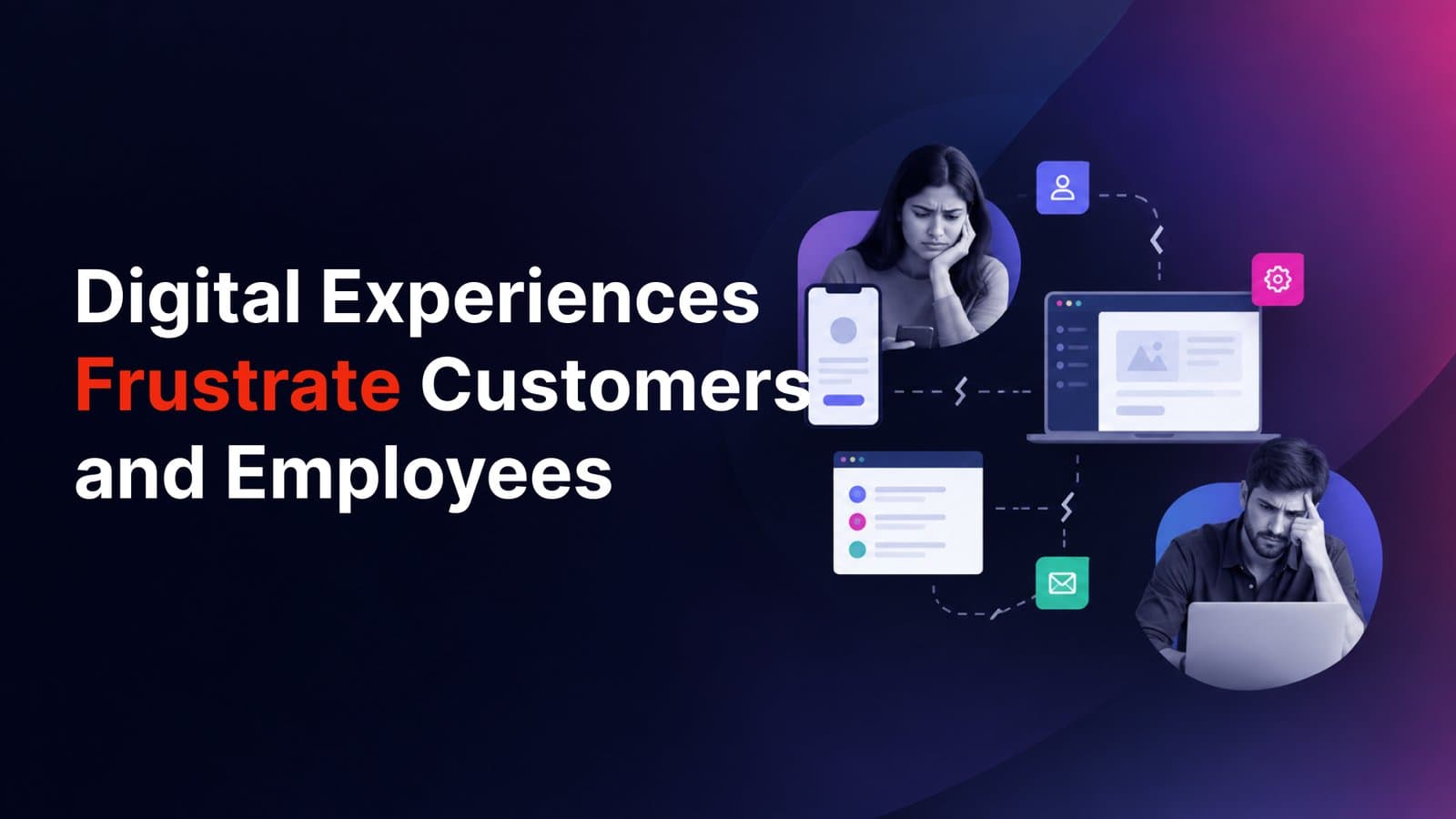

A customer starts a support conversation on chat, gets transferred to email, and then has to explain the same issue again on a phone call.nAn employee needs three different portals to request time off, check their pay, and find a company policy.nNone of these interactions are particularly difficult. The frustration comes from having to repeat the journey every time the system changes underneath it.nWhen digital experiences feel stitched together, people notice. Customers question whether the business understands them. Employees wonder why simple tasks require so many steps. And the technology becomes part of the problem instead of helping people get things done.n
The Experience People Actually Have
Businesses often think about digital channels individually.nThere is the website. The mobile application. The customer support platform. The employee portal. The HR system. The intranet.nEach may work perfectly well on its own.nThe problem begins when someone moves between them.nA customer may provide information through one channel that isn't available to the next person they speak to. An employee may have to search several systems for information that should be easy to find. A status update made in one application may take hours to appear somewhere else.nFrom the user's perspective, these aren't separate technology systems.n
They are one interaction with the business.n
When that interaction feels fragmented, the business pays for it through lost time, repeated work, lower satisfaction, and reduced trust.
Where the Friction Shows Up
The most obvious problems usually happen at the handoffs.
Customer supportn Customers repeat information because their history isn't available across channels.nEmployee servicesn People move between separate HR, IT, communications, and business applications to complete everyday tasks.nAccount informationn Different systems show different versions of a customer's details, status, or activity.nInternal knowledgen Employees know the information exists somewhere, but finding the right system becomes part of the task.nCommunicationn Customers or employees receive messages that don't reflect the latest information available elsewhere in the organization.nThese aren't necessarily signs that a business has chosen the wrong applications. More often, they show that the applications were never designed as one experience.n
Design the Journey, Not Just the Channel
The starting point for improving a digital experience shouldn't be another application.nIt should be the journey.nLook at what a customer or employee actually needs to accomplish and identify every system, handoff, login, and information exchange involved.nThat reveals where the experience breaks down.nA customer support journey might cross a website, CRM, contact centre, and service platform. An employee journey might involve an intranet, HR system, collaboration platform, and IT service desk.nOnce those dependencies are visible, businesses can prioritize the moments where better connectivity will have the greatest impact.nThe objective isn't necessarily to replace every system.n
It's to make the journey feel simpler than the technology behind it.
One Experience Doesn't Require One System
A connected experience doesn't always mean putting everything onto one platform.nExisting applications can often remain in place while integration connects the information and workflows between them.nAPIs can allow systems to exchange information. CRM integration can give customer-facing teams access to a more complete history. Digital workplace platforms can bring frequently used employee services into one starting point. Intranets and portals can provide a consistent front door to information that still lives across multiple systems.nThis approach allows businesses to improve the experience without taking on the risk and cost of replacing everything at once.nThe technology should disappear into the background.nPeople shouldn't have to think about which system is responsible for a particular piece of information. They should simply be able to complete the taskn
What Makes a Connected Experience Work
Connectivity alone doesn't guarantee a better experience.nContext matters. People should not have to repeat information that the business already has.nConsistency matters. Information, status, messaging, and design should make sense across touchpoints.nSecurity matters. Connecting systems increases the importance of identity, access controls, and data protection.nOwnership matters. Someone needs responsibility for the experience across the journey, not just for an individual application.nAdoption matters. Employees need to understand and trust the new experience, otherwise they'll continue using the old ways of working.nThese considerations become even more important as businesses add new applications and digital channels.n
The Business Value of a Connected Experience
For customers, a connected experience reduces repetition and makes interactions feel more personal and reliable.nFor employees, it removes unnecessary navigation and gives them faster access to the information and services they need.nFor the business, it can reduce manual work, improve data consistency, simplify support, and make new digital services easier to introduce.nMore importantly, it creates a consistent relationship with the organization.nWhether someone is using a mobile application, speaking to support, accessing an employee portal, or searching an intranet, the experience should feel like it belongs to the same business.n
Conclusion
The answer isn't necessarily another platform. It's understanding how people move through the business and connecting the systems behind the moments that matter.nAthen helps businesses connect applications, information, and digital workplaces to create simpler experiences for both customers and employees.n
If your customers or employees are navigating too many disconnected systems, talk to Athen about creating a more connected digital experience.