A Detailed Engineering Perspective on AI-Assisted Frontend Workflows


Frontend development is evolving faster than ever before. Over the last few years, the industry has shifted from traditional UI development towards AI-assisted engineering workflows. Modern tools such as ChatGPT, GitHub Copilot, and AI-powered IDE assistants are changing how developers build, debug, optimize, and deploy applications.
1. Evolution of Frontend Engineering
The frontend ecosystem has undergone massive transformations:
• From jQuery to Component-Based Frameworks
• From Monolithic Applications to Micro Frontends
• From Manual Styling to Utility-First CSS
• From Client-Side Rendering to Server Components
• From Traditional Coding to AI-Assisted Development
2. Modern Frontend + AI Workflow Architecture

Today, AI supports developers throughout almost every stage of the software lifecycle. Instead of replacing developers, AI acts as an engineering accelerator.
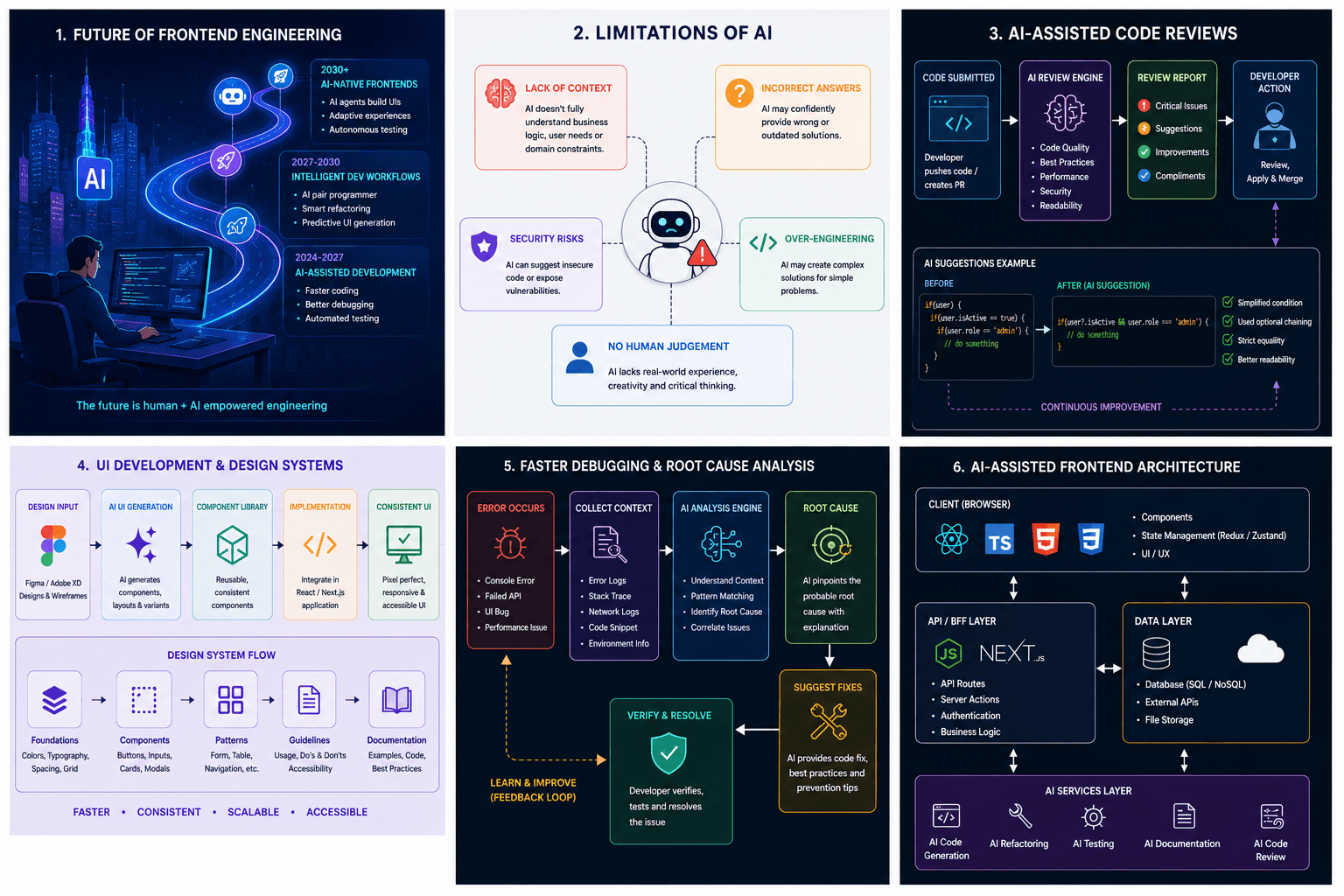
3. Faster Debugging & Root Cause Analysis
One of the biggest productivity improvements comes from AI-assisted debugging.
Before AI:
• Manual console logging
• Searching Stack Overflow
• Reading documentation for hours
• Trial-and-error debugging
After AI:
• Faster issue identification
• Better understanding of TypeScript errors
• Hook lifecycle debugging
• State management issue detection
• Dependency conflict analysis
4. Boilerplate Code Generation
AI significantly reduces repetitive implementation work by generating:
• React Components
• TypeScript Interfaces
• Validation Schemas
• API Integration Layers
• Formik Forms
• Reusable UI Structures
• Redux / Zustand State Setup
5. UI Development & Design Systems
Modern frontend applications require scalable design systems and responsive UI architectures.
AI helps accelerate:
• Responsive layout generation
• Tailwind CSS structures
• Accessibility improvements
• Dashboard UI creation
• Component hierarchy planning
• Design consistency
6. Learning New Frontend Architectures Faster
Frontend technologies evolve continuously.
AI makes learning faster by simplifying concepts such as:
• React Server Components
• Server Actions
• Full-stack React Architecture
• Rendering Optimization
• Modern State Management
• Performance Engineering
7. AI-Assisted Code Reviews
Before creating Pull Requests, AI helps identify:
• Edge Cases
• Readability Improvements
• Rendering Optimizations
• Unnecessary Re-renders
• Complex Condition Simplification
• Maintainability Improvements
8. Limitations of AI
Despite its advantages, AI still has several limitations.
AI may:
• Generate incorrect logic
• Suggest outdated approaches
• Misunderstand business requirements
• Produce over-engineered solutions
Experienced developers remain essential for:
• Architecture Decisions
• Scalability Planning
• Security Considerations
• Performance Engineering
9. Future of Frontend Engineering
The future of frontend development is not about AI replacing developers.
The future is about developers who effectively combine:
• Technical Expertise
• Problem-Solving Skills
• System Design Knowledge
• AI-Assisted Engineering Workflows
These developers will build applications faster, maintain systems more efficiently, and deliver better user experiences.